Manchester United have struggled at the start of the new season under manager Michael Carrick, but their main attacking problem may not be about chance creation as some believe, but rather how and to what extent they exploit those chances.
Carrick was known for relying on a style that combines ball possession and pitch control, playing at a slower tempo with precise passing exchanges, similar to his previous team Middlesbrough's best periods between 2022 and 2025, but he chose a completely different approach upon his return to Old Trafford.
Carrick began his tenure with a 2-0 victory over Manchester City, achieving an Expected Goals (xG) tally of 2.3 compared to just 0.5 for City, despite his possession rate not exceeding 32%. This was followed by a 3-2 win against Arsenal at the Emirates Stadium with a possession rate of 44%, according to data revealed by Squawka.
Carrick also succeeded in overcoming the rest of the "Big Six" teams: Tottenham Hotspur (2-0), Chelsea (1-0), and Liverpool (3-2). Manchester United only had more possession than their opponents in the match against Thomas Frank's Tottenham, which saw Cristian Romero sent off in the first half.
Moving to the current season, we find that the "Red Devils" are struggling to impose their dominance on the flow of play. Although any football club finds it easier to create chances through counter-attacks (quick transitions) than by building play against organized and compact defenses, Manchester United seem unable to cope with this challenge. However, chance creation may not be their main problem.
Chance creation is not Manchester United's crisis
There are several factors that can easily explain why Manchester United's performance has declined this season compared to last; the team had longer breaks between matches, and their participation was limited to the Premier League when Carrick took charge.
They are now facing compact and low blocks at nearly double the rate they faced last season (48.5 times per match versus 26.5 times).
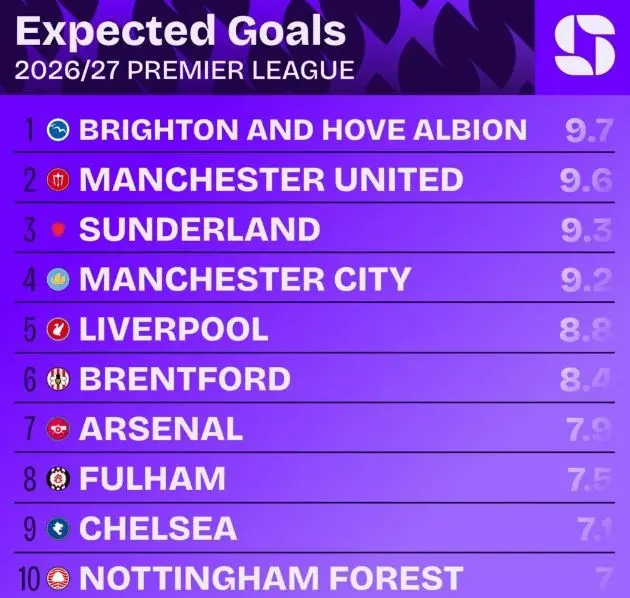
Despite this, the "Red Devils" remain among the top 6 teams in many statistics related to creativity and chance creation. The team ranks second in the Premier League this season in terms of the Expected Goals (xG) index with 9.6, behind only Brighton.
Good numbers for Manchester United stars, but...
Manchester United also rank sixth in terms of "big chances" (15 chances), fifth in shots with an xG value of 0.15 or higher (15 shots), and shots with an xG value of 0.20 or higher (11 shots).
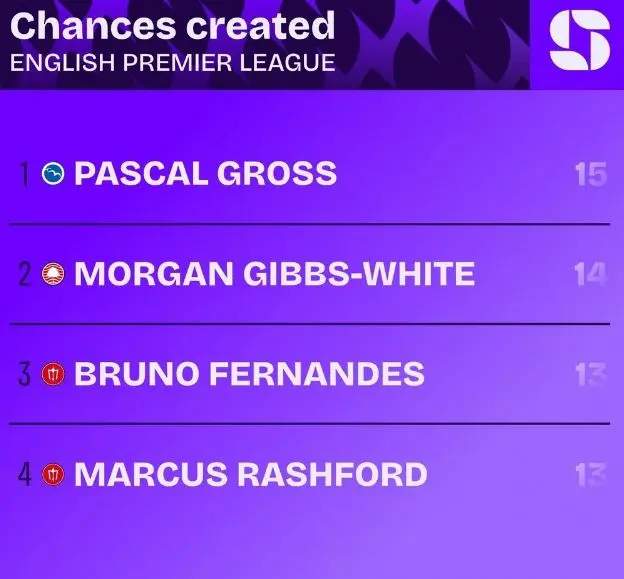
On an individual level, there are also notable figures; two of the top four players in chance creation in the Premier League so far play for Manchester United, namely Bruno Fernandes and Marcus Rashford.
The problem lies in how they handle those chances, as evidenced by their ranking fifth in the list of teams that waste the most such chances (10 chances).
Carrick's squad worst in "how they miss chances"
The conversion rate for Manchester United's stars reaches 33%, which exceeds the league average of 32%. However, Manager Michael Carrick's men rank fifteenth in terms of Expected Goals (xG), having scored 1.6 goals fewer than expected.
Worse than simply missing chances is the poor way in which they squander all these opportunities. According to Squawka, the "Red Devils'" Expected Goals index of 9.6 effectively drops to 6.4 when calculating the post-shot Expected Goals (post-shot xG).
This means the probability of scoring was higher before the shot than after it. No other team has performed so poorly in directing shots like Manchester United; their difference (-3.2) is the worst in the league by a significant margin.