
Among the many deals Chelsea struck this summer, the signing of Austin MacPhee was the most intriguing. MacPhee joined the coaching staff of new manager Xabi Alonso after Chelsea triggered the release clause in his contract with Aston Villa, ending a five-year tenure during which the Scottish coach established himself as one of the most respected and valued set-piece coaches in the Premier League.
Last season, set-piece coach Bernardo Cueva helped Chelsea achieve a respectable tally from attacking set-pieces, but dealing with set-pieces at the other end of the pitch remained a glaring weakness; no team conceded more goals from set-pieces in the Premier League than Chelsea, except for Liverpool, Bournemouth, and Crystal Palace.
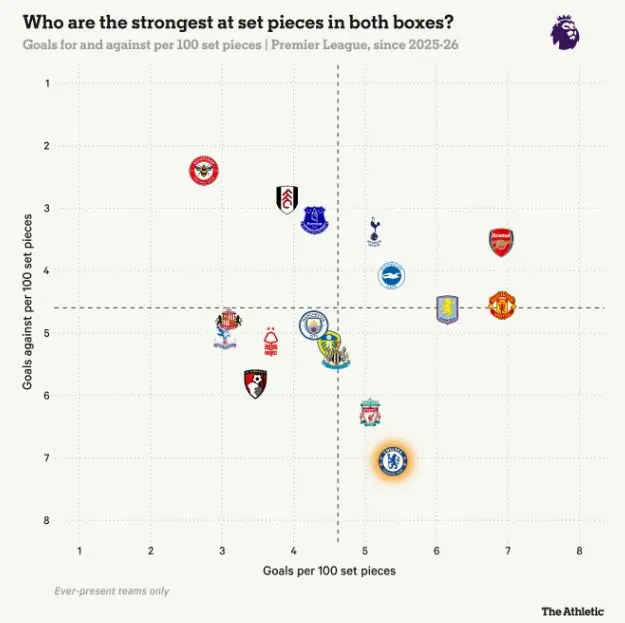
During the first five league matches under MacPhee, glimpses emerged of the innovative attacking routines that characterized his time at Aston Villa. Although we are still early in the season, Chelsea’s four goals scored from set-pieces place them joint-top in this aspect of the league.
However, the defensive numbers are also striking: the team has conceded five goals from set-pieces – the worst record in the league – while their "expected goals against" rate in such situations (three goals) is exceeded only by Brighton.
As shown in the chart below, Chelsea’s performance in the 2025-2026 season is slightly better than the Premier League average regarding scoring from attacking set-pieces, but no team concedes goals at a higher rate when defending against these situations compared to Chelsea’s rate, which stands at approximately seven goals per 100 set-piece instances.
Chelsea struggles to effectively counter opponents’ corners and long throw-ins. The Blues entered the international break with the worst defensive record in the Premier League, having conceded a goal from both scenarios mentioned during their 3-0 away defeat to Brentford in their last match. Defender Levi Colwill expressed optimism about coach MacPhee and his new ideas, but offered sharp criticism of the team’s stance and execution of those concepts.
Colwell told Sky Sports: "Our level wasn't good enough. Sometimes we were outmuscled (in set-pieces) and we need to improve in that area, but we trust our set-piece coach. We are still adapting to new things, but we desperately need to improve as a team."
Brentford’s first goal that evening was indicative of some larger issues Chelsea faces when defending corners.
MacPhee employs a strategy involving placing all ten outfield players (excluding the goalkeeper) in the zone between the goal and the penalty spot, tasking his best aerial defenders with man-marking duties using a "zonal marking" system around the six-yard box surrounding goalkeeper Emiliano Martínez.
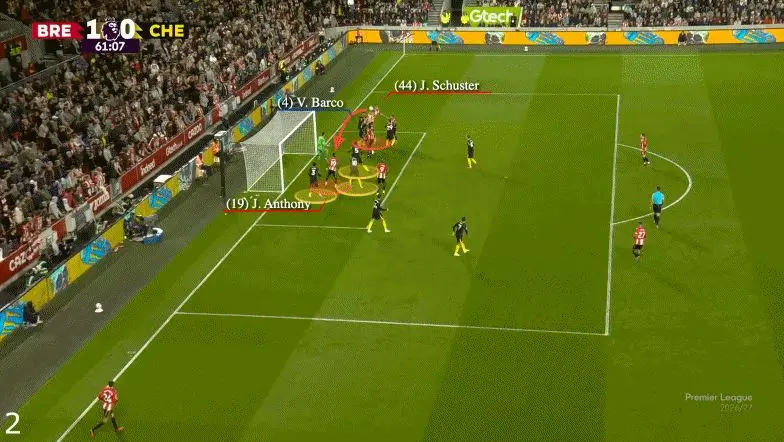
In contrast, Brentford places player Jaidon Anthony in front of Martínez, while directing their most dangerous players toward the far post to increase numerical density there; where Yannick Schuster – who is 190 cm tall – finds himself in direct confrontation with Valentín Barco – who is 170 cm tall.
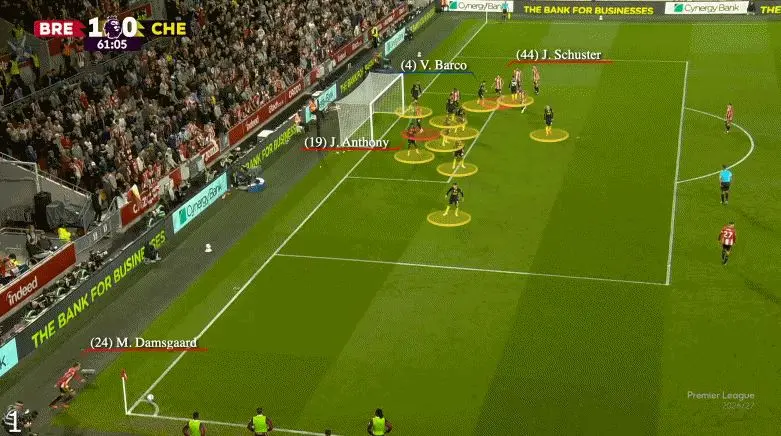
As expected, Schuster overpowers Barco physically to receive the inswinging cross delivered by Mikkel Damsgaard. Although Martínez pushes Anthony away as he turns to track the ball's trajectory, three Chelsea defenders fail to deal with the presence of Brentford’s winger, leaving him completely free to convert Schuster’s header across the six-yard box into the net from very close range.
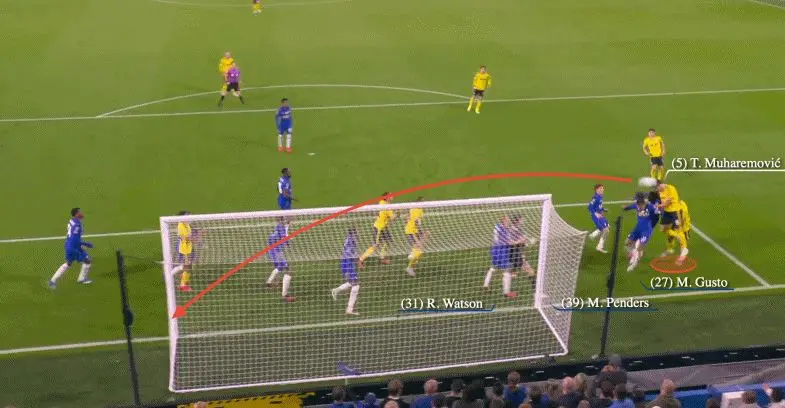
Brentford was not the first team this season to target Chelsea’s defense at the far post during corners. Leeds United had previously achieved a similarly fruitful result in an exciting nine-goal Carabao Cup match at Stamford Bridge earlier in the week; where player Tarik Muharemović – who is 190 cm tall – exploited his physical advantage over Malo Gusto (178 cm) to score with a brilliant header that flew past goalkeeper Mike Penders.
Chelsea displays deeply concerning performance by allowing opponents dangerous scoring opportunities from close range when defending set-pieces. Since the start of last season, the team has conceded 13 goals from inside the six-yard box, a figure exceeding what any other Premier League team has suffered.
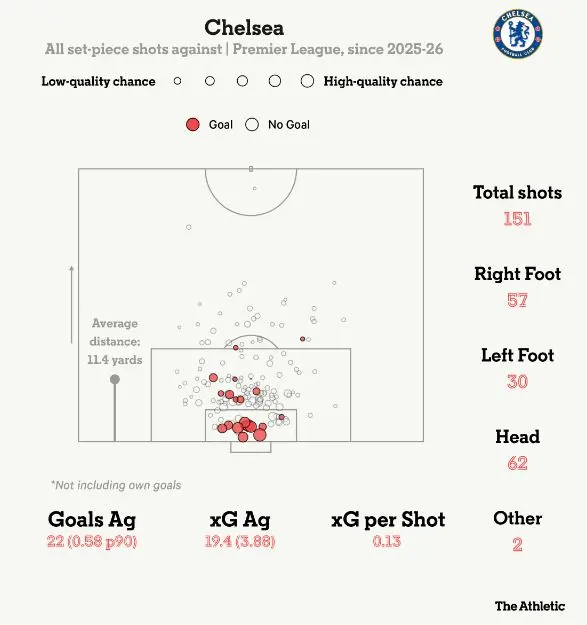
Five of those goals resulted from long throw-ins, a scenario Brentford exploited to deepen Chelsea’s misery in the final minutes of the match played at the Gtech Community Stadium two weeks ago.
Brighton also exploited this vulnerability regarding long throw-ins in the final minutes of the thrilling seven-goal match between the two teams at Stamford Bridge on August 30.
Whether it concerns corners or long throw-ins, or whether the goal comes from the first touch or in the second or third phase of play, it has been far too easy to breach Chelsea’s net from set-pieces for far too long.
The appointment of MacPhee in the summer confirmed the club’s awareness of this problem, and his methods are likely to bring the required improvements over time. Furthermore, his long-standing relationship with goalkeeper Emiliano Martínez, dating back to their years working together at Aston Villa, should help build greater defensive cohesion.
However, despite the 46-year-old coach being widely regarded as one of the best specialists in handling set-pieces, it is worth noting that his predecessor, Cueva, also arrived from Brentford with an impressive record in this aspect of the game.
Once the players step onto the pitch, the ability of any specialist set-piece coach to influence results becomes limited. Despite reinforcing the squad with tall and physically strong players during the summer transfer window, Chelsea still suffers from a lack of aerial dominance compared to many of their Premier League rivals, and they will need to perform better in upcoming matches to improve their results in the Premier League.